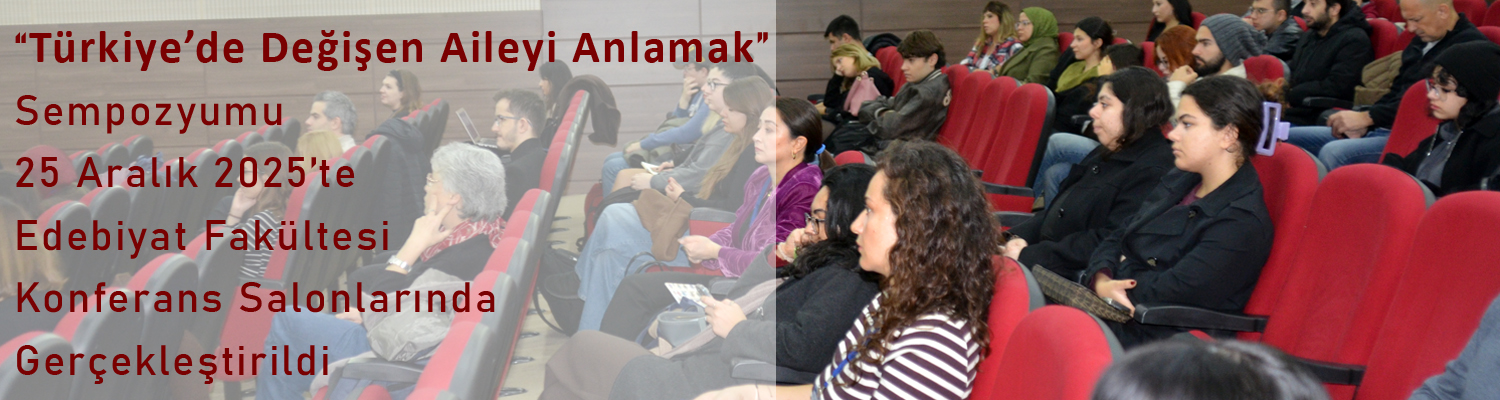
On the 25th DEcember, 2025, a symposium entitled “Understanding the Changing Family in Türkiye” was organized by the Ege University Research Centre for Women’s Studies (RCWS) and held in the Conference Halls of the Faculty of Letters. The organizing committee consisted of Prof. Dr. Şerife Çağın (Head of the Department of Women’s Studies, Institute of Social Sciences), Dr. Vildan Koçoğlu Gündoğdu (Director of RCWS), Dr. Dilek Maktal Canko (Director of the Ethnography Museum), and Dr. İlkay Südaş and Dr. Sinem Utanır Altay (Deputy Directors of RCWS).
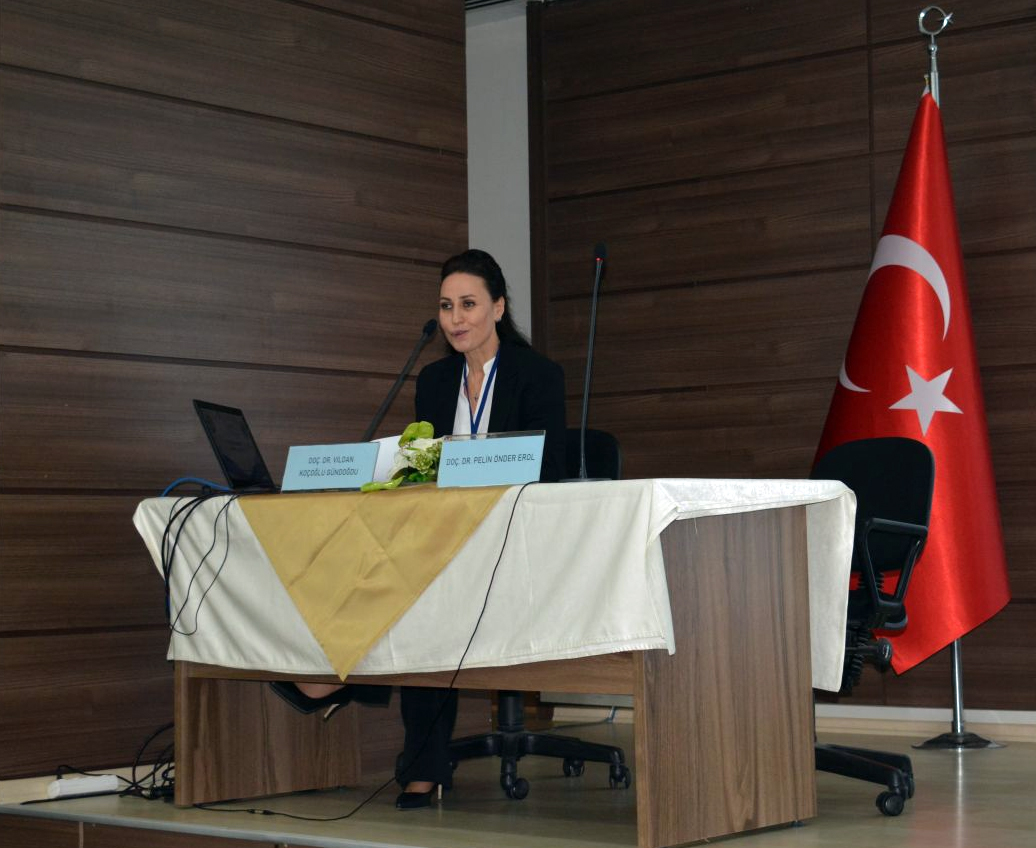
Dr. Koçoğlu Gündoğdu and Dr. Pelin Önder Erol, during their opening speeches.
The symposium opened with welcoming speeches delivered by Dr. Vildan Koçoğlu Gündoğdu and Dr. Pelin Önder Erol. The event brought together academics and students to examine the transformation of the family institution, changing gender roles, and contemporary family dynamics from an interdisciplinary academic perspective.
In her opening address, Dr. Koçoğlu Gündoğdu emphasized that recent demographic changes in Türkiye point to a profound structural transformation in the population. She highlighted declining fertility rates, increasing ages at marriage and childbirth, shrinking household sizes, and the growing proportion of the elderly population, noting that these trends are likely to have long-term implications for social services, care policies, and the labour market. She further underlined that the discussions held during the symposium would contribute to the development of evidence-based family policies, the strengthening of women’s social status, and the expansion of social welfare mechanisms. Stressing the importance of understanding social change and its underlying causes from an academic perspective, she also emphasized that women should be regarded as active agents of development. In addition, she noted that single-parent families, childless households, reconstituted families, and single-person households have become prominent social realities in contemporary Türkiye. While processes of individualization may enhance personal autonomy, she argued, they simultaneously generate new vulnerabilities in social solidarity and care relations.
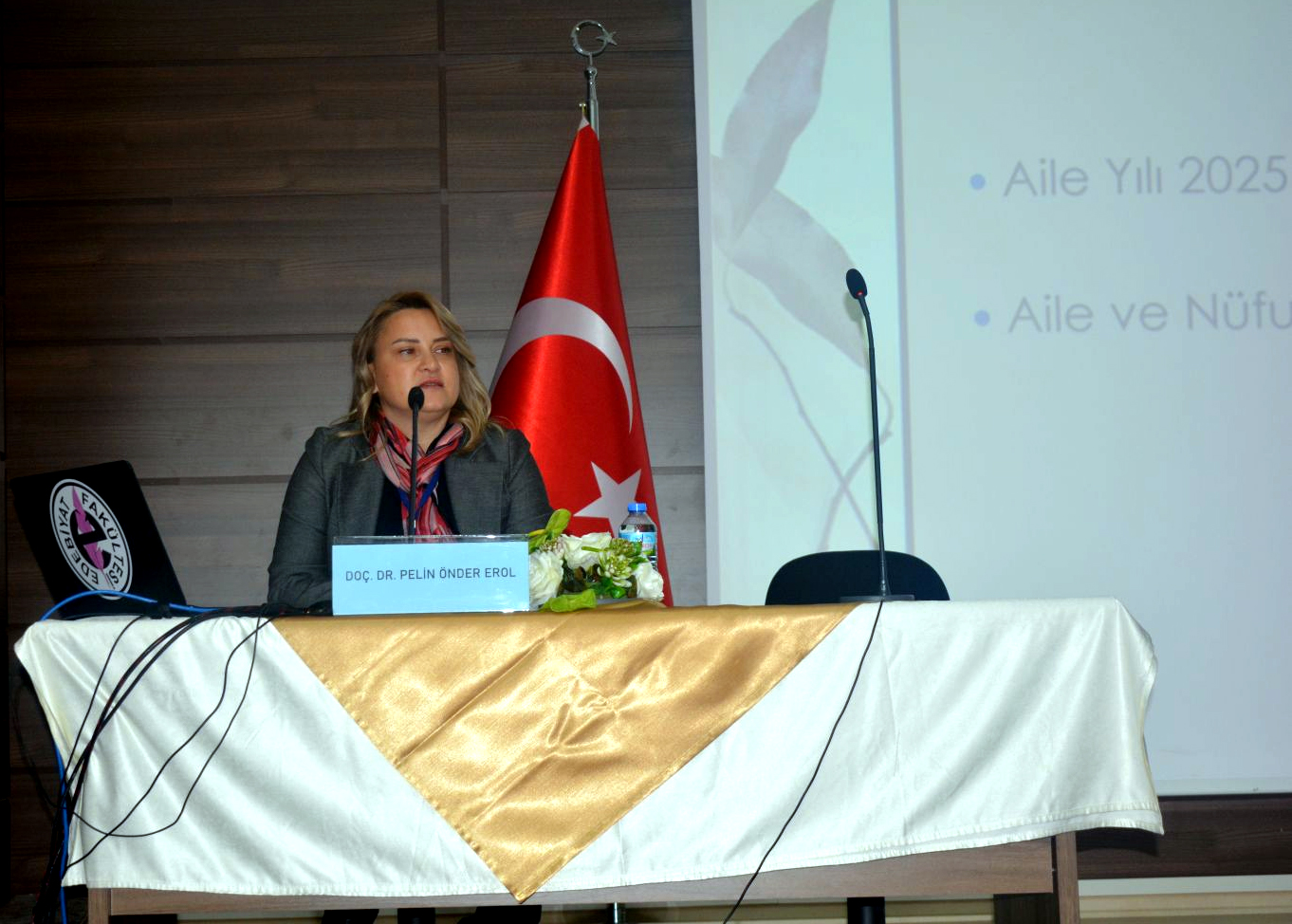
The invited keynote speaker of the symposium was Assoc. Prof. Dr. Pelin Önder Erol from the Department of Sociology, Faculty of Letters, Ege University. In her presentation, she examined the transformation of the family institution and the multidimensional nature of this change within the framework of demographic transition and second demographic transition theories. Her presentation was entitled “An Assessment of the Relationship Between Family and Population.”
Following the keynote address, the symposium continued with parallel sessions. The first session, held in the Nuri Bilgin Hall, focused on demographic change. In this session, Dr. Elmas Burcu Karataş presented her paper entitled “Invisible Labor and Demographic Winter: A Sociological Critique of the Discourse of Intra-Family Solidarity.” This was followed by a joint presentation by Dr. Duygu Altınoluk, Dr. Nihan Ozansoy Tunçemir, and Dr. Elif Baş entitled “Overlapping and Diverging Trends in Turkish Family Structure Within the Context of Second Demographic Transition Theory.” The session concluded with Ayşe İzci’s presentation, “Historical Transformation of the Family Institution in Turkey and New Family Models: A Socio-Cultural and Demographic Assessment.”
The second session addressed the emergence of new public spheres shaped by social media. Dr. Gamze Bilir Seyhan presented two papers entitled “Social Media Activism in the Context of Changing Family Structures in Turkey: A New Public Discourse in the Field of Adoption” and “The Transformation of ‘Family Honor’ and the New Position of the Father Figure in the Digital Public Space: The Rojin Kabaish Case.” Zeynep Can presented her paper entitled “‘Sharenting’ Practices in Turkey: A Review of Gender and Family Dynamics,” followed by Dr. Sinem Çapar İleri, who delivered the final presentation of the session on the same topic.
The final session in the Nuri Bilgin Hall focused on issues of digitalization and representation. Dr. Yusuf Yılmaz presented “The Family in the Digital Age: The Transformation of Communication Practices and the Impact of Digitalization on Family Relationships.” Melisa Karataş followed with “From ‘Priceless’ to ‘Expensive’: The Transformation of the Family and Its Representation in the Media in Turkey in the Context of Fertility Rates.” The session concluded with Ecem Dönmez’s presentation entitled “Being a Family and the Representation of Women in the Media: The Case of the Television Series Uzak Şehir (Distant City).”
Parallel sessions also continued in the Ahmet Arslan Hall. In the first session, Gökçe Pekmezci presented “A New Trend in the Turkish Population: Single Living in Metropolitan Areas.” This was followed by a joint presentation by Müzeyyen Hazal Beydeş and Dr. Pelin Önder Erol entitled “The Effect of Socio-Economic Factors on Homogamic Attitudes: The İzmir Case.” Dr. Ceylan Aydın concluded the session with her presentation “The Transformation of Childhood in Turkish Novels from the Tanzimat Era to the Present: Literary Representation and Social Change.”
The second session in the Ahmet Arslan Hall focused on challenges faced by families. Dr. Ayla Deniz and Emre Keloğlu presented “The Impact of Earthquakes on Family Life: A Study of Families Migrating to Ankara and Mersin After the Kahramanmaraş Earthquakes.” Dr. Deniz also presented “Divorce in Mixed Marriages and the Post-Divorce Experiences of Immigrant Mothers.” The final paper of the session, entitled “‘There Was Love in My Story, but the Path Still Led to Separation’: The Significance of Family Members’ Approaches for Transgender Women,” was presented by Ani Nar.
The final session, again held in the Ahmet Arslan Hall, addressed artistic and historical perspectives on family. Dr. Dilek Maktal Canko presented “Understanding the Byzantine Family,” followed by Zehra Güneş’s “The Political Function of the Child in the Seljuk and Ilkhanid Periods.” Dr. E. Charlotte Nelson then presented “Population, Family, and Power: Womanhood in the Late Ottoman Period from a Biopower Perspective.” The session concluded with Özlem Bostancı’s presentation entitled “The Transformation of the Family Image in Turkish Painting: From Rural Reality to the Modern Nuclear Family.”
The symposium concluded with an interactive workshop held between 15:30 and 17:00. Pedagogy experts Dr. Duygu Metin Peten, Dr. Semra Sütgibi, and Dr. Uwe Krause conducted a workshop entitled “The Family and the Position of Women within the Family in the Context of the Atlas of European Values,” developed as part of an international Erasmus project. The workshop took place in Classroom 1101 and employed a range of participatory teaching methods.